How to Choose Printed Pizza Boxes for Your Business
Choosing printed pizza boxes means balancing brand visibility with heat, grease, stacking pressure, and delivery time. A sharp logo matters. But a soggy base, a loose lid, or faded ink can weaken the customer’s experience before the first slice is served. The National Restaurant Association’s 2024 State of the Restaurant Industry report highlights off-premises dining as an ongoing part of restaurant operations. That makes packaging a practical part of the service, not just a surface for promotion.
Material choice deserves equal attention. The U.S. Environmental Protection Agency’s 2018 Advancing Sustainable Materials Management report found that containers and packaging made up 28.1% of U.S. municipal solid waste generation that year. The figure covers many kinds of packaging, not pizza boxes alone, but it offers useful context when comparing materials and disposal claims. Ask suppliers for product-specific details rather than relying on broad environmental language.
This guide explains how to compare box sizes, board strength, ventilation, grease resistance, print quality, and order costs. A large box may look impressive, yet leave a small pizza sliding during delivery. Tiny details matter. Consider testing samples with your actual pizzas, sauces, and delivery routes before placing a full order. It is easy to focus on the artwork and miss how a box performs after twenty minutes in a courier bag. That happens. A reliable choice should protect the food, represent your brand clearly, and fit your budget without making unsupported claims about sustainability.
Define Pizza Size, Delivery Conditions, and FDA Food-Contact Requirements
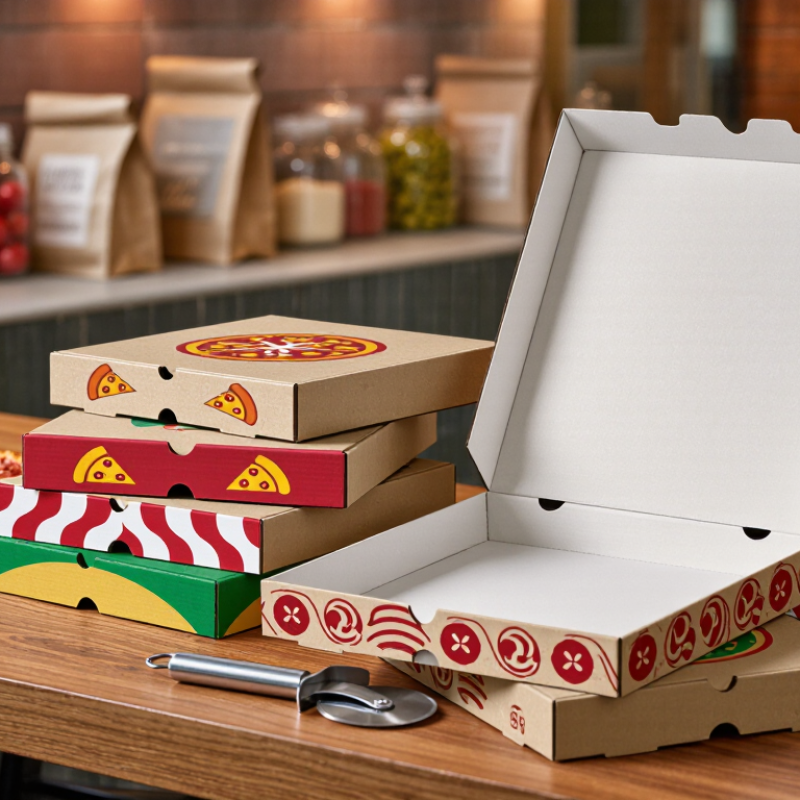
A printed pizza box should fit the pizza, not just match its listed diameter. Measure the pie across its widest points, including the crust, and allow enough room to lift the lid without scraping cheese. A 12-inch pizza may need a box with slightly more interior space. Check the box depth too, especially for thick crusts or tall toppings. Small details matter.
Delivery changes the choice. A short pickup trip creates different demands than a 40-minute drive in a warm car. Corrugated board helps protect the pizza, while carefully placed vents can release steam and limit a soggy crust. Too much ventilation, though, may let heat escape faster. Test boxes with real orders: stack them, carry them, and inspect the pizza after a typical delivery route. That test may reveal problems a sample on a desk will not.
For food-contact safety, ask the supplier for documentation showing that the box materials meet applicable FDA requirements for their intended use. FDA compliance depends on the materials and conditions of use; it is not a blanket approval of every printed box. Confirm that inks and coatings are suitable for the application, and keep printing on the exterior where practical. I would still verify the finished box with the supplier, because a vague “food-safe” claim leaves important questions unanswered.
Compare Board Strength Using Edge Crush and Burst-Test Ratings
When comparing printed pizza boxes, read the board’s edge crush test (ECT) and burst-test ratings as different measures. ECT measures how much force a corrugated board edge can withstand before crushing. It can help assess stacking strength during storage and delivery. Burst testing measures the pressure needed to rupture the board. That matters when boxes may be squeezed or handled roughly.
Compare ratings only when the test method, units, and board construction are comparable. A higher number is not automatically better for every shop. A busy delivery route with boxes stacked in a warm vehicle may call for stronger board than quick counter service. Still, moisture, box design, and how tightly staff stack orders can affect performance. Not a perfect proxy. Ask the supplier for documented test results, then check a sample under your own conditions.
Fold several boxes and inspect whether corners hold their shape and lids stay closed. Stack filled boxes for the length of a typical delivery run, not just a few minutes. If the lower boxes buckle or the top box slides, reconsider the board grade or box dimensions. Ratings help narrow the choice, but a small trial can reveal issues the test figures miss. Sometimes the lighter option works; sometimes it doesn’t.
Choose Grease Resistance Based on TAPPI T 559 Kit-Test Results
A printed pizza box must resist oil without becoming stiff, bulky, or difficult to fold. TAPPI T 559 offers a practical way to compare paperboard grease resistance. The kit test exposes a sample to graded oil-like mixtures, then records the highest kit level that does not visibly stain or penetrate the sheet. Higher ratings generally indicate stronger resistance in this test.
Ask for results from the actual printed and converted board, not only an unprinted sheet. Printing, creases, glued seams, and small coating gaps can change how grease moves through a box. Check more than one area, especially corners and folds. Keep the tested sample and its rating with your purchasing records. That makes supplier comparisons more meaningful.
A high kit rating is useful, but it does not reproduce every delivery. Hot cheese, oil pooling, steam, and time in a delivery bag can create different conditions. Test filled boxes with your own pizza and typical holding time, too. A score can look reassuring on paper. Real use may still surprise you. Consider whether the result matches your menu, serving temperature, and expected delivery window; no single test captures every customer’s experience.
How to Choose Printed Pizza Boxes for Your Business - Choose Grease Resistance Based on TAPPI T 559 Kit-Test Results
Use the example ratings below as planning targets, not as measured product results. TAPPI T 559 reports a kit rating on a scale from 1 to 12; a higher rating indicates resistance to more aggressive test solutions. Have the finished board tested under the applicable method before specifying or making performance claims.
| Pizza-box use case |
Typical grease exposure |
Illustrative T 559 target |
Selection guidance |
Checks before ordering |
| Lightly topped pizzas |
Low to moderate; limited visible oil on the base |
Around 4–6 |
Consider an uncoated food-contact board if trials show acceptable performance for the intended service time. |
Check the box bottom and seams after holding a representative pizza for the expected delivery period. |
| Standard cheese and meat toppings |
Moderate; oil may transfer to the inner liner during holding |
Around 6–8 |
Compare suitable grease-resistant board options and select the lowest-performing option that passes realistic package trials. |
Review print rub, fold cracking, odor, food-contact suitability, and performance at the intended box weight and size. |
| Oil-rich or heavily topped pizzas |
High; greater likelihood of staining or penetration during extended holding |
Around 8–10 |
Prioritize a verified grease-resistant inner surface; confirm that the chosen treatment and board are suitable for the intended food contact. |
Test filled boxes under representative temperature, stacking, and delivery-time conditions; inspect edges and score lines as well as flat areas. |
| Long delivery or takeaway holding time |
Variable; exposure increases with time and depends on toppings and packaging conditions |
Set from trials; often 8 or higher for evaluation |
Use the kit result as a screening measure, then validate the complete printed and converted box in a time-based use test. |
Include realistic ventilation, stacking, and handling; a kit rating alone does not predict every package-use outcome. |
| Printed exterior with an unprinted food-contact interior |
Depends on the inner board surface and pizza; exterior print does not establish interior grease resistance |
Rate the relevant food-contact surface |
Specify the surface to be tested and keep inks and coatings appropriate for the packaging construction and intended use. |
Confirm the test specimen represents the actual board surface; separately assess migration and other applicable food-packaging requirements. |
Practical rule: compare kit-test results obtained using the same method and comparable specimens. Confirm the laboratory’s conditioning and reporting details, and validate the selected printed box with the foods, holding times, and delivery conditions it is designed to serve.
Plan Print, Ink, and Venting for Food Contact and Moisture Control
Printed pizza boxes need to manage three things at once: ink, food contact, and steam. Keep graphics on the outside, and ask the supplier for documentation on ink suitability and migration testing for the intended board and printing process. A dry-looking surface is not proof of safety. This part is easy to overlook.
Moisture control needs testing with a real pizza, not just a flat sample. Steam trapped under the lid softens the crust; oversized vents can cool the food and dry its edges. Test the box after a realistic delivery interval, checking condensation, crust texture, and whether the lid warps. Small details matter. The USDA estimates that 30–40% of the U.S. food supply is lost or wasted, a broad reminder that keeping food appealing matters. But packaging alone cannot prevent waste. Material choices matter too: the U.S. EPA’s 2018 Advancing Sustainable Materials Management report found a 96.5% recycling rate for corrugated boxes. Grease and local collection rules can change whether a used pizza box is accepted, so confirm local guidance before making recycling claims. A clean proof can still mislead. Test it hot.
How to Choose Printed Pizza Boxes for Your Business
Plan print, ink, and venting for food contact and moisture control.
The 1–5 values are a qualitative planning guide, not laboratory measurements or regulatory ratings. Confirm that materials and inks are suitable for their intended food-packaging use, keep printing off food-contact surfaces, and test moisture resistance and venting with the actual box and pizza.
Verify Samples with ASTM D642 Compression and Delivery Tests
Printed pizza boxes must protect the meal, not just carry a design. Before approving a print run, request samples made with the intended board grade, dimensions, and print finish. Test them using ASTM D642, a method for measuring a container’s compression strength. Ask the testing provider to record sample conditioning, load, and deformation. A single peak-load number can hide weak corners or uneven panel collapse. Watch how the lid and sidewalls behave under pressure.
Tips: Stack filled boxes to a realistic height, then check for crushed edges, sticking lids, and shifted toppings. Also run delivery trials over actual routes. Include turns, short waits, and temperature changes. Keep notes and photograph each sample before and after testing.
Compression results are useful, but they do not reproduce every delivery condition. A box may hold a static load yet soften when exposed to steam or grease. That is easy to overlook. Compare several samples, and test them after realistic contact with a hot pizza. If one sample fails, adjust the board, fold design, or vent placement, then repeat the checks. No test is perfect; the goal is to find weaknesses before customers do.